
Can local SEO generate genuine enquiries for a trade service without an established business reputation?
We built a new website targeting timber deck construction searches across Wellington, Lower Hutt and Upper Hutt. Over 12 months, the project generated 24 tracked inbound enquiries attributed to organic search, with $0 spent on Google Ads.
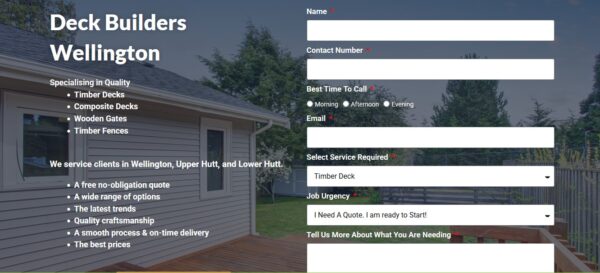
This was an internal rank and rent SEO experiment designed to measure what a structured local search strategy could achieve from a standing start.
Below, we will explain the approach, show the performance data and discuss what established New Zealand trade businesses can learn from the results.
Metric | Result |
|---|---|
| Trade Industry | Timber Deck Construction |
| Target Location | Wellington, Lower Hutt and Upper Hutt |
| Project Type | Internal rank and rent SEO test |
| Ad Spend | $0 |
| Google Reviews | None |
| Existing Brand Presence | None |
| Measurement period | 12 Months |
| Tracked Organic Queries | 24 |
| These figures describe one test project. They are not a forecast or guarantee of results for other businesses. |
Established trade businesses often benefit from years of local experience, customer referrals, repeat business, reviews and brand recognition.
Those advantages are valuable, but they make it difficult to isolate how much a website’s organic search visibility contributes to generating enquiries.
We wanted to test a narrower question:
Could a new website generate measurable local search visibility and inbound enquiries without relying on an established brand or paid advertising?
To investigate this, we built a website in the timber deck construction niche and focused on organic search as the acquisition channel being tested.
The project started without an established brand, customer base or Google Ads campaign. It was an SEO experiment, not a fully operational trade business with an existing reputation.
That distinction matters. We wanted to measure the performance of the website’s organic search strategy, rather than attribute every result to a combination of marketing channels and existing business advantages.
The website was built around three priorities:
Rather than relying on a generic homepage to target every search, we organised the website around the services being offered.
The objective was to make it clear what the website covered and which pages were relevant to particular searches.
This involved clear page titles, descriptive headings, relevant service content, logical navigation and straightforward enquiry paths.
The principle was to give each important page a defined purpose instead of trying to make one page rank for every service and location.
The project targeted Wellington, Lower Hutt, Upper Hutt and surrounding suburbs.
Location focused pages were created to connect the timber deck construction service with relevant local searches.
Examples of the intended search themes included:
The aim was to establish relevant service and location coverage across the target market.
Creating a suburb page alone does not guarantee rankings. Each page still needs a clear purpose, useful information and a meaningful relationship to the service being offered.
We kept the website lightweight and focused on usability and search accessibility.
The implementation included:
These elements supported the wider website structure. No individual technical change guarantees rankings; the objective was to create a coherent website that visitors and search engines could understand.
Over the 12 month measurement period, the website generated 24 tracked inbound enquiries attributed to organic search.
No Google Ads spend was used to generate those enquiries.
The project also recorded organic search impressions, clicks and visibility for relevant service and location searches.
The key measure was not simply whether the website could rank. It was whether organic search activity translated into tracked opportunities for contact.
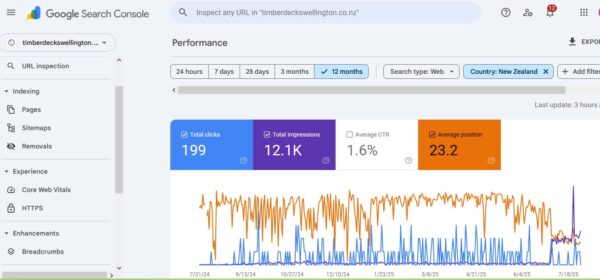
The graph provides context for how organic search visibility developed over the measurement period. When interpreting it, distinguish between appearing in search results, earning clicks and generating enquiries.
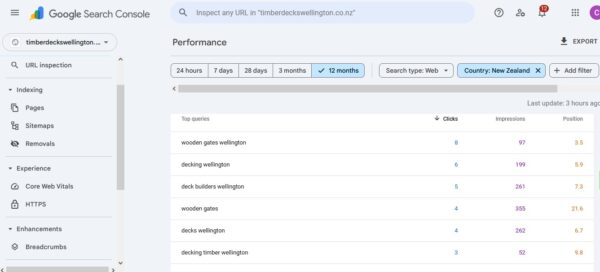
Your query data helps show which searches brought the website into Google’s results and which attracted clicks.
Use verified ranking data when reporting specific keyword positions. Search Console average position is not necessarily the same as a manually observed ranking at a particular location and time.

The website generated 24 tracked inbound enquiries attributed to organic search through form submissions and phone tracking.
Remove personal information from any screenshots before publishing.
These enquiries provide a more commercially relevant measure than impressions or rankings alone. However, an enquiry is not automatically a qualified lead, a quote or a completed job.
The experiment produced 24 tracked organic enquiries over 12 months without Google Ads or an established brand.
That is evidence that this particular website generated measurable enquiries through organic search under the conditions tested.
The different data points help explain the result:
Impressions indicate how often the website appeared in search results.
Clicks show how often searchers visited the website from those results.
Enquiries indicate that some visitors went on to make contact.
These measures describe different stages of the customer journey. A website can gain impressions without attracting clicks, and clicks do not necessarily translate into enquiries.
That is why we track outcomes beyond rankings alone.
The results also need to be interpreted in context. Twenty-four enquiries do not establish how many jobs were won, how profitable those jobs were or how another trade business would perform using a similar strategy.
The value of the test is that it provides a real example of organic search performance that can be examined through the recorded data.
A new website and an established trade business are not identical starting points.
An established business may already have genuine customer reviews, completed project photographs, a recognised name, years of experience and a history of serving its local community.
These assets can contribute to customer confidence and support a broader marketing strategy.
The opportunity is to combine those existing strengths with a website structured around the services and locations the business wants to target.
For established trade businesses, the practical lessons are:
Local SEO is a longer term investment, and outcomes vary with competition, website history, implementation and market demand. The goal is to build relevant organic visibility and measure how it contributes to the business.
At Clicks4Business, we approach local SEO as part of a broader marketing system for established trade businesses.
Depending on the business, this can bring together:
The right combination depends on the business’s existing position, competition, target services and growth objectives.
This case study focuses on organic search in isolation. Our wider Growth Partner System considers how SEO, paid advertising, website performance and enquiry tracking can work together to support business growth.
Explore our services:
Local SEO may be a good fit if you operate an established New Zealand trade business and want to improve your visibility in the areas you serve.
It can be particularly relevant if you want to:
The first step is to assess your current website, the searches your customers make and the competition in your target locations.
From there, you can identify the opportunities worth pursuing and determine how to measure progress.
Want to understand the local SEO opportunities for your trade business?
Book a Growth Strategy Review with Clicks4Business to discuss your website, target locations and growth objectives.
Local SEO for trades typically takes 3–12 months to deliver noticeable results. The timeframe depends on factors such as competition in your area, the keywords you’re targeting, and the current state of your website. Ranking on the first page of Google for competitive keywords generally takes longer than achieving initial rankings. With consistent SEO work, you can gradually improve your visibility and attract more local customers.
Yes. Local SEO can generate enquiries through organic Google search results without paying for advertising clicks. In our timber deck construction case study, a brand-new website generated 24 tracked organic enquiries over 12 months with no Google Ads spend, no existing brand recognition, and no Google reviews. While results vary by trade, location, and competition, this demonstrates that a well-structured local SEO strategy can generate enquiries on its own.
Local SEO helps your trade business appear when potential customers search Google for services in your area. This includes optimising your website for specific services and locations, improving your Google Business Profile, and building relevant local visibility. For tradies, the focus is on appearing for searches made by people looking to hire, such as an electrician in a particular suburb or a local deck builder, rather than simply increasing website traffic.
Suburb pages help Google understand which services you offer and the areas you serve. A well-built page can target searches related to a specific service and location, such as “deck builders Lower Hutt” or “electrician in Porirua”. The key is to make each page genuinely useful, with relevant service information and local details. This helps you build visibility in the areas that matter most to your business.
Yes. When SEO is built around the services, locations, and types of jobs you want, it can help attract customers who are actively looking for that work. For example, an electrical business might target switchboard upgrades or commercial installations instead of focusing solely on general electrician searches. SEO cannot guarantee the quality of every enquiry, but targeting the right search intent can help reduce irrelevant leads and create more opportunities for profitable work.
We offer services for trade businesses who want control, clarity and growth.